Words Have Consequences

Download PDF Report >>>  Words Have Consequences

Download ACA PDF file >>> Affordable Care Act

Download HIPAA PDF file >>> Public Health Service Act

Illinois appears to follow guidelines for enrolling individuals into the state’s Affordable Care Act’s (ACA) pre-existing condition insurance plan, but Illinois’ interpretation of  the  ACA’s wording may be questioned. In its interpretation, Illinois does not allow enrollment if a person has insurance coverage even though it excludes pre-existing conditions.

A virtually contradictory interpretation can be found on the federal government’s website HealthCare.gov.  The federal government sets conditions of who is eligible to apply to the government for pre-existing condition insurance plans in states that opted out of participation. To apply, you will need to provide a copy of one the following documents:

  • A denial letter from an insurance company licensed in your state for individual insurance coverage (not health insurance offered through a job) that is dated within the past 6 months.  Or, you may provide a letter dated in the past 6 months from an insurance agent or broker licensed in your state that shows you aren’t eligible for individual insurance coverage from one or more insurance companies because of your medical condition.
  • An offer of coverage from an insurance company licensed in your state for individual insurance coverage (not health insurance offered through a job) that is dated within the past 6 months. This offer of coverage has a rider that says your medical condition won’t be covered.
govt pre-existing condition insurance apply

It is not logical that if a state runs the program, it can exclude people, while if the federal government runs the program, those same people could be included in the plan.

This analysis explores in more detail how Illinois and by extension, other states may have come to the conclusion they did and why that may not be the correct interpretation.

Illinois Pre-existing Condition Insurance Plan (IPXP)

To qualify for insurance in IPXP, a person must meet three conditions that seem to mirror the text of the Affordable Care Act. The Affordable Care Act (ACA) established eligibility criteria for federally funded high risk pools like the IPXP.  The pertinent wording of the Affordable Care Act that states in section 1101 (d).  An individual shall be deemed to be eligible … if such individual:

  1. Is a citizen or national of the United States or is lawfully present in the United States
  2. has not been covered under creditable coverage (as defined in section 2701(c)(1) of the Public Health Service Act as in effect on the date of enactment of this Act) during the 6-month period prior to the date on which such individual is applying for coverage through the high risk pool; and
  3. Has a pre-existing condition

These same provisions in IPXP require that
To enroll, a person must:

  1. Be a U.S. citizen, national, or legal resident;
  2. Be uninsured for 6 months; and
  3. Have a preexisting condition.”

The IPXP application specifically notes regarding item 2, “that if you currently have insurance coverage that doesn’t cover your medical condition, you are not eligible for IPXP”.

This raises the question of how Illinois adopted their meaning of ACA’s wording. Words have consequences and so it is important to determine what the Public Health Service Act (HIPAA) actually said and meant by its use of the phrase “creditable coverage” and did Illinois misinterpret it?

Public Health Service Act (HIPAA)

HIPAA’s opening paragraph sets forth its purpose: “… to improve portability and continuity of health insurance coverage in the group and individual markets, to combat waste, fraud, and abuse in health insurance and health care delivery …”

HIPAA contains five main components or “Titles”, the first of which is “HEALTH CARE ACCESS, PORTABILITY, AND RENEWABILITY”.  That title is divided again into two subtitles, “Group Market” and “Individual Market”.

In general, under Individual Market Section 2741(a)(1) health insurers may not decline coverage to or impose any pre-existing condition exclusion on “eligible individuals”.  However, Section 2741(a)(2) allows states to implement an “acceptable alternative mechanism”.  One acceptable alternative is a state managed high risk pool which Illinois has, so private health insurers in Illinois may deny coverage or include pre-existing exclusions in their policies since an alternative is available.

However, the act does not change the definition an “eligible individual” which is one who (a) has 18 or more months of “creditable coverage” and (b) whose most recent prior “creditable coverage” was under a group health plan.

CREDITABLE COVERAGE DEFINED

HIPAA defines “creditable coverage” in Section 2701(c)(1) to mean with respect to an individual, coverage of the individual under any of the following:  a group health plan; health insurance coverage; or… any of 8 other government health insurance plans.  “Such term does not include coverage consisting solely of coverage of excepted benefits (as defined in section 2791(c))”.

GROUP HEALTH PLAN DEFINED

Creditable coverage refers to coverage in a “group health plan” that also needs definition. A group health plan Sec. 701(a)(1) means an employee benefit plan that provides payment for medical care directly through insurance, reimbursement, or otherwise.  In short, what most people think of as basic group health insurance.

EXCEPTED BENEFITS DEFINED

Creditable coverage also introduces another concept – “excepted benefits”. Including this definition allows a contrast to group health plans that provide creditable coverage.  Given the number of excepted benefits, of which only a sample is shown below, it is clear that HIPAA intended only a few basic types of basic health benefits to be considered creditable coverage.

Excepted benefits as defined in Section 2791(c) includes but is not limited to:

  • Coverage only for accident, or disability income insurance, or any combination thereof.
  • Coverage issued as a supplement to liability insurance.
  • Liability insurance, including general liability insurance and automobile liability insurance.
  • Workers’ compensation or similar insurance.
  • Limited scope dental or vision benefits.
  • Benefits for long-term care, nursing home care, home health care, community-based care, or any combination thereof.
  • Coverage only for a specified disease or illness.
  • Medicare supplemental Insurance.

Combining references and definitions from HIPAA, to be eligible for ACA’s pre-existing condition insurance plan, prerequisite #2 requires an individual to:

  • have 18 or more months of a group health plan that provides payment for medical care, AND
  • have not been covered for 6 months under either a group health plan or a health insurance coverage

Now if an adult person is unemployed, has recently graduated or lost a job, that individual is not likely to be covered by a group health plan. Such individual, however, may be insured under individual health insurance coverage of which there are several types, of which one of the more common is “short-term limited duration insurance.”

INDIVIDUAL HEALTH INSURANCE COVERAGE

Section 2791 (b) (5) states: The term ‘individual health insurance coverage’ means health insurance coverage offered to individuals in the individual market, but does not include short-term limited duration insurance. Oops.  This means that HIPAA considers one of the more common forms of individual health insurance not to be insurance at all.

PULLING IT ALL TOGETHER IN ILLINOIS

Recall from the beginning of this essay, the IPXP application form specifically states “that if you currently have insurance coverage that doesn’t cover your medical condition, you are not eligible for IPXP”. This requirement is NOT one of the ACA requirements.  And ACA in turn, references HIPAA that pointedly declares “short-term limited duration insurance” does NOT constitute insurance coverage at all. Conclusion: Illinois may have incorrectly defined short-term limited duration insurance as health insurance which definition specifically contradicts HIPAA definition.

CONCLUSION

It is clear that both the intention as well as the wording of the ACA  and HIPAA acts allow persons who once had but were later denied health coverage or who have coverage but with pre-existing exclusions, to apply for and receive coverage under the ACA pre-existing condition insurance plans.

Allegedly, enrollment in state ACA pre-existing condition insurance plans has been running behind projections. Is it possible states are restricting enrollment in a manner similar to Illinois?  It is something worth investigating further.

Disclaimer: While having extensive years of legal experience demonstrated in this analysis, the author is not a licensed attorney. What has not been verified is whether later amendments to the HIPAA changed any of the provisions mentioned above.

 Download PDF Report >>>  Words Have Consequences

Download ACA PDF file >>> Affordable Care Act

Download HIPAA PDF file >>> Public Health Service Act

Insurers’ Efforts to Shift Admin Costs to Medical Costs

Download PDF Report >>> Insurers’ Efforts to Shift Admin Costs

Senator Rockefeller recently came out with a report cautioning about health insurers efforts to shift Selling, General and Administrative (SGA) expenses to medical costs.  A shift would increase medical loss ratios (MLR) allowing insurers to keep more earnings. Two uncertainties affect predictions.  First is how plans are grouped and second is how one computes “medical costs” and “premiums”.  Below are reasonable interpretations of the new law that favor consumers, not insurers.

HOW ENROLLEES ARE GROUPED

The first order is to define “group.”  The more groups are combined, the greater the opportunity for balancing out gains and losses, which is the whole idea of insurance.  Continue reading

Consider Having only two Insured Groups – Self-Insured and Community Rated

Download PDF Report >>> Consider having two insured groups

Anthem’s recent announcement of rate hikes of up to 39% highlights a serious problem with the health insurance industry.  Despite public consternation, Anthem can justify the increase using legitimate risk analysis. The problem is not entirely Anthem. The problem is a marketplace in this country that defies logic, and has done so for decades.  All private health insurers including Anthem are benefiting from this absurdly inefficient market.

The U.S. is not one single homogeneous insurance market. Rather, it is multi-tiered divided between government and private.  Government pays almost 50% of all medical costs for the 30% of population on Medicare and Medicaid.  The private market is further divided into self-insured and risk segments, roughly split 50:50 by population.

The self-insured consist of large enterprises that have so many members that it costs more to buy insurance than to pay medical expenses themselves and have insurers only administer claims.  Insurers make a profit on administrative expenses, but nothing on medical costs.  Medicare operates the same way as self-insured, contracting membership and claims to insurers.  Insurers make nothing on any self-insured claims because the insurers carry no medical risk.

Service fees on self-insured groups of the top 10 insurers average 6% of insured premiums. Medicare overhead runs even less. Adding government and self-insured costs, some 75% of all insured U.S. health care is administered with expense ratios of about 5%.  Continue reading

Affordable Care Act – Table of Contents

Download PDF Report >>> Senate bill TOC

The Affordable Healthcare Act for All Americans is without a doubt, a large and complex piece of legislation at just over 2,400 pages.  But how big is 2,400 pages when wide margins, lines numbered, text double spaced, large font,  multiple levels of indent, and more than a few references to other documents?  The sample page below (standard 8.5 inch wide paper) is indicative of the 2,400 page document. The actual content is but a small fraction of a page. AHA legal text sample

Aside from the claims of too lengthly and complex, Republicans argued that this was a Democratic bill rammed through congress.  Interestingly, AHA includes more than 160 Republican amendments accepted during the month-long mark-up through just one committee (HELP), one of the longest in Congressional history.

Critics have claimed it’s a government takeover of our health system.  It may be news to those critics but half of the health system is already government-run.  And the great bulk of the reform bill deals with steps to improve existing government systems that has hardly drawn any attention.  The following provides a quick breakdown of the law sections.  The PDF report that can be viewed/downloaded shows the entire table of contents.

There are 10 “Titles” or major topics in the bill.  Only the first, at 374 pages, less than one sixth of the entire bill deals with changes to how the private sector handles health care. Yet, this is the section that has garnered nearly all the criticism. The bulk of Title I deals with prohibiting abuses by the insurance industry, which, if you ask on an issue by issue basis, most people will agree with the new provisions. Nothing in the bill involves a “takeover” of private insurers.

The next three Titles [II,III,IV] deal with improving Medicare and Medicaid programs and comprise 852 pages, one-third of the bill.  These Titles address reduction of waste, fraud and abuse, and pilot new payment methods towards a “results” oriented method common in most other industrialized countries.  There are few objections to this section.

Title V, at 256 pages, addresses anticipated shortages of primary physicians and other healthcare workers due to services that will be required by aging baby boomers.  This is totally opposite the “death panels” that ration healthcare that unfortunately got too much press for a falsehood.

Title VI uses 323 pages to improve transparency and integrity, yet more efforts to reduce waste, fraud and abuse in both the public and private health sectors. Who objects to efforts like this?

Title VII  improves Access To Innovative Medical Therapies, with focus on lowering the cost of drugs

Title VIII addresses ‘‘Community Living Assistance Services and Supports Act’’ or CLASS Act. This title The purpose of this title is to establish a national voluntary insurance program for purchasing community living assistance services and supports.  Moving people from higher cost hospitals and nursing homes to assisted living lowers costs, a laudable goal.

Title IX includes the revenue provisions that include provisions to raise revenue to pay for the expanded coverage.

The final Title X addresses 1) Medicaid and CHIP, 2) Support for pregnant and parenting women, and the major section 3) Indian health care improvements.  None are controversial issues.

Title I——-Quality, Affordable Health Care For All Americans [374 pages – 14%]

Title II——Role Of Public Programs [221 pages – 8%]

Title III–—Improving The Quality And Efficiency Of Health Care [501 pages – 19%]

Title IV–—Prevention Of Chronic Disease And Improving Public Health [130 pages – 5%]

Title V——Health Care Workforce [256 pages – 9%]

Title VI–—Transparency And Program Integrity [323 pages – 12%]

Title VII-—Improving Access To Innovative Medical Therapies [65 pages – 2%]

Title VIII—Class Act [53 pages – 2%]

Title IX—–Revenue Provisions [93 pages – 3%]

Title X——Strengthening Quality, Affordable Health Care For All Americans [373 pages – 14%]

.

Download PDF Report >>> Senate bill TOC


Insurers Hide Profitability Behind Return on Sales

Download PDF Report>>> Insurers Hide Profitability Behind Return on Sales

SUMMARY

Health insurance companies have repeatedly claimed their earnings were a very modest 3-5% return on sales. Implicit in their claim is that many others earn far greater returns.  But comparing sales ratios to other industries can be misleading.

High value added industries like software have high sales margins.  Low value added industries like groceries and insurance and have low sales margins. While health insurers may not compare well with the high valued group, they show very fair returns compared with lower added value industries.

Other financial ratios used to compare include ROI and ROE that key not on sales but on gross and net investment. How much money was used to generate profits.  Here the picture is significantly more favorable for health insurers. They are not only near the top of basic industries, but are well positioned compared with more discretionary industries.

RETURN ON SALES

Return on sales, while prevalent, is not the only financial ration used to compare performance.  Each ratio has its strengths and weaknesses.  The weakness of return on sales is that it completely obscures the differences in the value companies add to the goods and services that they sell.

The chart below highlights returns for three industries based on value added. (Ratios are for example only.) The bottom bar represents high value added firms like computer software where purchased goods and services are nominal compared to what they pay their staffs and what they earn on sales.

The mid range covers companies like manufacturers who buy raw materials and intermediate goods, perform significant steps (like conversion and assembly) incurring added costs, and (hopefully) sell at a margin above their internal costs.

Finally, at top are industries where the bulk of their costs are purchased, like groceries and insurance, and while they add value it is small compared to their purchase costs.

In all three cases, a consistent ratio of internal costs of 60% and margin of 40% was applied.  But notice that the margin on final sales (at 100%) ranges from 36% for high value added industries to only 4% for low value added. To rely on returns based on sales is meaningful only within industries with similar value added components.

INDUSTRY COMPARISON OF RETURN ON SALES

Ratios of returns on sales are also influenced by where they stand on a “necessity” scale.  Sales for basic items like food, housing, and utilities, tend to be fairly stable and many of their costs are simply “passed through” to the customer. The more the pass through, the lower the markups tend to be.

Conversely, purchases discretionary purchases for luxuries, entertainment, and cell phones can be expected to have higher margins.  Sales levels are more affected by economic conditions and higher margins compensate for greater risks.

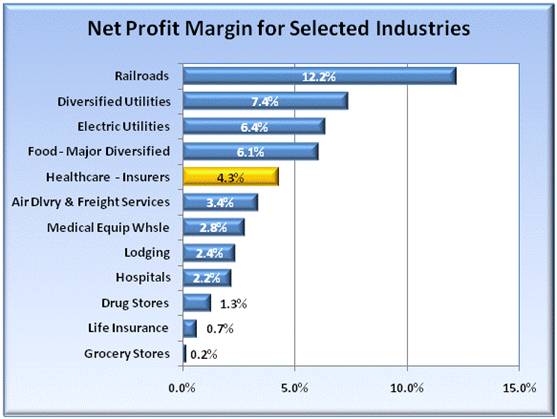
As noted, health insurers act like the poor kid on the block using net profits on sales.  It is true that a group of industries have far better returns than health insurers as shown below. The chart shows returns based on net profit margins divided by sales (Source: Yahoo Finance – Industry Index by Sector).

Insurers ARE the “poor kids on this block.”  But look at the “block.” Cigarettes, beer, wine and liquor, golf clubs and perfume, cell phones and cable TV.  These industries can hardly be defined as meeting basic customer needs.  These are discretionary purchases that can cut back on during tough times.  Purchases of basic necessities are harder to cut back.

Below is a different group of industries covering more basic needs. One would reasonably assume that health insurance is a basic industry and where value added is small compared to total costs.  While Health Insurers (gold bar) may not be the highest in this group either, they are by no means the lowest.  What you don’t see are these other industries complaining about their low returns on sales as health insurers do.

OTHER FINANCIAL RATIOS:  ROI/ROA AND ROE

With wide swings in returns based on sales revenue, Wall Street uses several other ratios to compare rates of return. One is return on investment (ROI).  Buy a CD and earn 2.5%.  It’s simple.  ROI = 2.5%.  Now buy a house. Pay cash and it’s just like a CD.  But if you take out a mortgage, you have leveraged your returns.  Your house will change value the same regardless of how much equity you have invested. But your Return on equity investment (ROE) is different.

The chart below shows how this works. Assume you buy a house and take out a mortgage for 60% of the purchase. A number of years later, you sell the house for 20% more than you paid.  If you had paid cash, your return would be 20%. But if you had mortgaged 60%, you put up only 40% cash and your return is a 50% (20% return /40% cash invested). ROE is similar to return on investment (ROI) or assets (ROA) but reflects only the net amount of equity investment.

INDUSTRY COMPARISON OF RETURN ON EQUITY

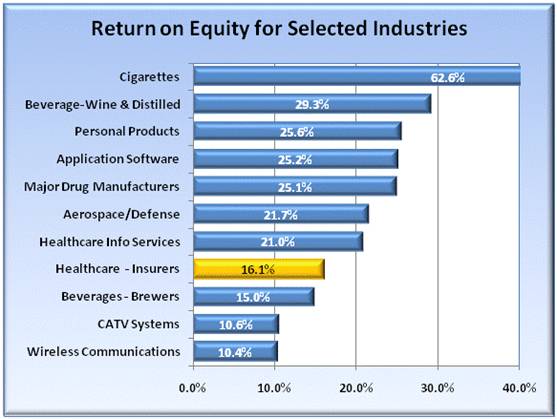
Previously described were two groups of industries, those dealing in basic necessities, and those more in discretionary items.  The groups are the same but comparison is different, using the return on equity (ROE) ratio as just described.

Again we begin with the discretionary group where health insurers fared poorly.  Using ROE ratios, health insurers rose in rank, passing up beer, cable TV and cell phones.  Again, one has to ask whether anyone should be comparing the service provided by health insurers to be in this “block.”

Wall Street considers returns on equities in the 15-16% to be normal average for all industries. But again the question is whether health insurers should be considered “average” when they satisfy basic needs where lower ROE’s are expected.

Comparing health insurers with the same group of basic industries shown previously, the picture below dramatically changes.  Insurers are near the top of the group with the majority of industries coming in lower.  These industries are more suitable comparisons than insurers prefer to use.

One final observation.  Health insurance used to be heavily non-profit. For profit insurers came later as life insurance companies began to diversify into more profitable fields.  Now look at the ROE for life insurance: at the bottom.

Download PDF Report>>> Insurers Hide Profitability Behind Return on Sales

Fact Check: Provider Consolidation Driving Up Costs

Download PDF Report >>> Fact Check – profits and consolidation

Fact Check:  Provider Consolidation Driving Up Costs

  • · Massachusetts Attorney General issued a report that: “points to the market clout of the best-paid providers as a main driver of the state’s spiraling health care costs” and “found no evidence that the higher pay was a reward for better quality work or for treating sicker patients”.
  • · According to a new report in Health Affairs, Paul Ginsburg and Robert Berenson found that “providers’ growing market power to negotiate higher payment rates from private insurers is the ‘elephant in the room’ that is rarely mentioned.”
  • · According to a brief from the National Institute for Health Care Management: “With only a few exceptions, results consistently demonstrate that hospital consolidations result in higher prices for hospital services.”
  • · The Federal Trade Commission and the Depart­ment of Justice noted: “Most studies of the relation­ship between competition and hospital prices have found that high hospital concentration is associated with increased prices, regardless of whether the hospitals are for-profit or nonprofit.”

FACT CHECK CHECKED: The above are arguments that America’s Health Insurance Plans (AHIP) included in their response to advocates of reform. What AHIP may not recognize is it has set forth some of the most compelling arguments for a “public option”.

AHIP freely admits that insurers are powerless on their own to control provider costs. Even with anti-trust exemptions, they have failed to combine forces and confront providers.  Short of a government takeover, the only long-term solution is more clout.  The only entity with more clout is the government itself being an insurer, which, by the way, it already is – Medicare.

Medicare doesn’t so much “ask” providers what they charge.  Medicare almost “tells” providers what it will pay. Republicans were so concerned with Medicare’s clout that they wrote into law “prohibiting” negotiated drug discounts.  But discounts will become necessary.

For many Americans, a drastically reformed healthcare system was a non-starter.  The administration politically tried to blend features of the current into the proposed system to reduce upheaval to such a large part of the economy.  Any change can be unsettling, and how you view it is very important.  Is the glass half full or half empty?  At some point, radical cost control will occur, and private insurers will not be leading the charge.

Insurers can look on government as an unreasonable competitor or they can look on government as the only insurer who finally has enough clout to contain provider costs.  It may be that insurers eventually withdraw from the market for “essential medical benefits” and focus their efforts on supplemental policies that go beyond basic.  If they did, they would look a lot like health insurers in Europe and other industrialized countries. Diminished compared to today but not destroyed.

Download PDF Report >>> Fact Check – profits and consolidation

Fact Check: Put health plan profits in perspective

Download PDF Report >>> Fact Check – profits and consolidation

Fact Check:  Put health plan profits in perspective

  • Ezra Klein, Washington Post:… it’s hard to see how [health plan profit margins] are a primary driver of health-care spending, much less the growth in health-care spending.”
  • Henry Aaron, Brookings Institute: “Insurance company profits in the large picture have very little to do with the overall rising cost of health care.”
  • Kaiser Health:“With the nation’s health care spending estimated at $2.5 trillion this year, even the elimination of insurers’ profits and executive compen­sation would lower health care spending by just 0.5 percent.”

FACT CHECK CHECKED: Granted, the insurers cut is a miniscule piece of total costs.  But it is still billions of dollars of non medical costs.  Where are they spending them?  It should be in two areas: to responsibly manage insurance and contain costs. If insurers were managing just fine, reforms would not include rule after rule after rule to rein in unsavory practices that occur now.

Cost containment has two faces: price and volume. You can control one or both. Insurers can control volume by denying claims, and here they have been successful.  In the price area, they have utterly failed to contain prices from providers. But Wall Street is indifferent in how one generates earnings, only that one does.  Clearly, insurers’ focus is Wall Street and not Main Street.

Insurers claim they add value by negotiating discounts with providers.  But by insurers’ own admission, those providers simply raise their rates resulting in no actual cost reductions.  Insurers are adding virtually no value, but draw compensation as if they were saving billions.

All large companies pay cost control experts to contain costs. If they fail, the experts are fired or the companies go out of business. Yet insurers exert every conceivable pressure to maintain the status quo which they admit has been a failure in containing healthcare costs.

Download PDF Report >>> Fact Check – profits and consolidation

Fact Check: Lines of Business Obscure Profit Margins

Download PDF Report >>> Lines of Business Obscure Profit Margins

FACT CHECK: In 2009, the percentage of premiums that went towards administrative costs and profits declined for the sixth year in a row and have been consistent for decades.

FACT CHECK CHECKED: America’s Health Insurance Plans (AHIP) combines self-insured line of business (LOB) and insured LOB and presents the results as if it were one homogeneous market.   Nothing could be further from the truth. Size wise, the ratio of self insured LOB to insured LOB is roughly 58% / 42% of self-insured / insured or underwritten.

Insurers charge self-insured (ASO – administrative service only) groups an administrative fee that, for the top 10 health insurers, averaged 6.94% of costs.  That translates to 6.5% of “premiums” which are really medical benefits plus service fee income.  This “efficient” administrative expense is not evident in the insured LOB.

To identify the administrative costs and profits for the insured group, one computes and then removes the self-insured revenues and expenses from the CMS Totals as shown in the table below.  Sources and stepwise methodology (top to bottom) are shown in the far right column.

The claim that insurers’ average percentage of premiums that went towards administrative costs and profits was around 11.75% (and have been consistent for decades) totally obscures two radically different lines of business with divergent expense ratios.   For 2008, self-insured admin costs and profits were about 6.5% for self-insured groups, but about 18% for insured groups.  Since the profit margin is VERY slim for the self insured, the bulk of profits are born on the backs of the insured groups which include small business and individuals. A reasonable question to ask is “why are insurers satisfied with profit margins of well under 1% on 55 % of their business but feel a need to push margins well beyond 10% on 45% of their business?”  Though risk is a small factor in the insured LOB, they have to compete far harder on self-insured LOB than on insured LOB where they hold oligopoly power in local market areas and convert that market power into profits.

Download PDF Report >>> Lines of Business Obscure Profit Margins

Non-Partisan CBO Estimates of Healthcare Reform

Download PDF Report >>> CBO Estimate of Healthcare Reform

SUMMARY

Few doubt how unsustainable current medical trends are.  With medical inflation consistently outpacing the CPI, health costs will continue to take a greater share of the economy. Private insurers claim they can solve the problem with reform but without a Public Option.  History suggests this is a dubious claim at best.  Looked at from multiple angles, private insurers are not likely to succeed.  Profits gains have far exceeded key indices, medical loss ratios have gone way down while costs have gone way up, competition is diminished by concentration of major insurers, and tort reform complaints carry little water.

DISCUSSION

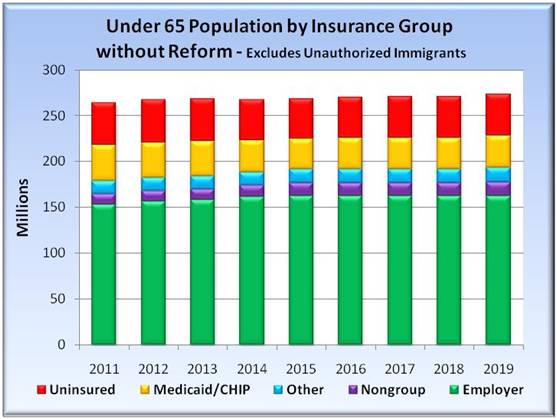
The graph below shows CBO projections of under 65 population by insurance group. The top, red bars are the uninsured that continue to grow each year.  While insurance through employment is fairly consistent, greater employee cost sharing is an increasing burden.

Neither the Senate nor House reform proposals provide financial support to unauthorized immigrants.  When analyzing various effects of reform, this group has no effect. For data consistency for both before and after reform, unauthorized immigrants are not included in the populations.  Removal lowers uninsured population between 5 and 8 million over the 10 year period.

 Source: CBO, Oct 7, 2009 letter to Senator Baucus

While the country may be coming to some agreement that reform is needed, differences exist on how to achieve reform. Health Insurers want to have participation mandatory which is a valid point. Except they have offered no other steps on how to reduce costs and are against Public Option that would offer real competition. However, they would be beneficiaries of millions of new customers.

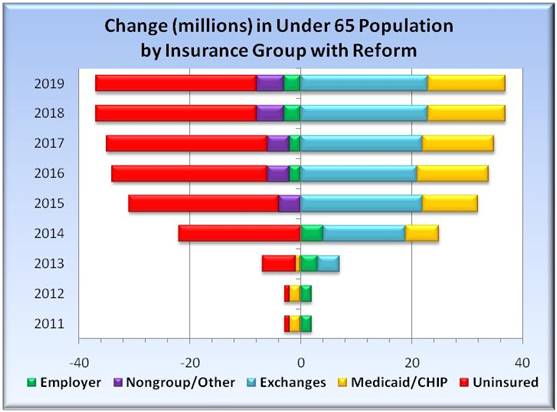
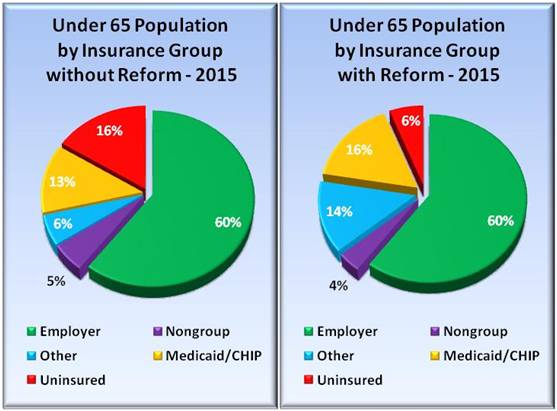
Those customers would come from those currently uninsured, or insured through individual and employer groups. In the graph next column, CBO assumes reform includes an Exchange that would shift nearly 40 million from uninsured, individual and employer groups (left side of graph) to Medicaid and the Exchange (right side).  Note that not all the movement is to the Exchange.  A large number of uninsured poor would switch to Medicaid.  Still, the Exchange is expected to grow quickly to nearly 25 million. This group is the target for private insurers and Public Option.

So why is it necessary to have a Public Option on the Exchange?

 On its face, private insurers could certainly cover 25 million new enrollees without government involvement. But the catch is that the government IS involved because of another feature of reform.

 Source: CBO, Oct 7, 2009 letter to Senator Baucus

That reform feature is “affordability credits”.  Even those with insurance find their total health care costs consume so much of their income that they do not get needed care. Affordability credits help those with lower incomes pay premiums and shared health costs. The effect is shown in the chart below. Medicaid pays for the very poor while credits help less well off people in the Exchange.

 Source: CBO, Oct 7, 2009 letter to Senator Baucus

In short, the Government will be paying some $100 billion each year in credits to Exchange enrollees, much of it going towards insurance premiums.  Will private insurers provide good value for this outlay? Their track record is not encouraging. 

Health care costs fall into two categories: medical cost outlays and administration / overhead costs. In 1993, 95% of premiums went for medical costs at Investor-owned insurers as shown below.  Over the next 14 years, this decreased to just above 80%, a shift of about 14% or one percent per year.  Meanwhile Medicare administration and overhead costs have remained fairly constant through the period.  While some may argue this is not a direct comparison, the fact that Medicare medical loss ratio stayed constant while investor-owned insurers drop significantly cannot be denied.

 Sources: PricewaterhouseCoopers’ Health Research Institute, and U.S. Center for Medicare & Medicaid Services

14% becomes urgent when you consider premium dollars as shown in the chart below. Private insurance runs over $600 billion. 14% of this is nearly $90 billion per year.  Fortunately, one-third of private insurers are non-profit.  But that leaves some $60 billion added overhead including contribution to profits since 1993.

Source: Center for Disease Control – Health, United States 2008 Figure 19

Profits did not grow to $60 billion, but they sure did grow as shown below, exceeding by a huge margin the S&P 500 and CPI for urban wage earners.  All the growth occurred since 2002.

Sources: U.S. Dept. of Labor, Bureau of Labor Statistics, Standard and Poors, and Health Insurers’ 10K’s

Not only did investors do well, but so did executives and all at the expense of people paying for health insurance. 7 insurance CEO’s drew nearly $70 million total compensation in 2008.

Still, Investor-owned insurers argue that their profits are a mere 3% of revenue.  Another and better measure is Return on Equity (ROE) which is profitability based on investment.  By this measure, health insurers are earning 17%.  From the chart below some industries do have greater returns, but 17% should be nothing to complain about.  The 10 insurers are even higher than credit card issuers.

Sources: 10K reports for top 10 Investor-owned Insurers and  CCH Almanac of Business and Industrial Financial Ratios, 2009 Edition

Now high returns to executives and investors might have some justification if private insurers were successful in containing and bringing down the major component of health care – medical costs.  Yet, year after year, medical costs outpace the CPI.  One could almost argue that insurers “administer” health care costs rather than provide a value added “management” of those costs.

Competition often has something to do with companies holding down costs.  In competitive markets, insurers need to maximize cost control efforts to maintain market share.  But is there really competition?  The graph below shows the market share of the top two insurers in each state weighted for population covered.

 Sources: AMA, Consumer Union, Sector & Sovereign analysis

Over half the U.S. population lives in states where two insurers control over 60% of the market.  That is not a good omen for competition.  For instance, insurers claim that their market share allows them to negotiate lower rates with providers.  It would not be fair to paint all insurers with the same brush. But a number of insurers have been found not to be driving down rates, but of negotiating with providers to NOT contract lower rates with their competition.  Instead of reducing costs, these illegal acts increase medical costs compared to a truly competitive environment.

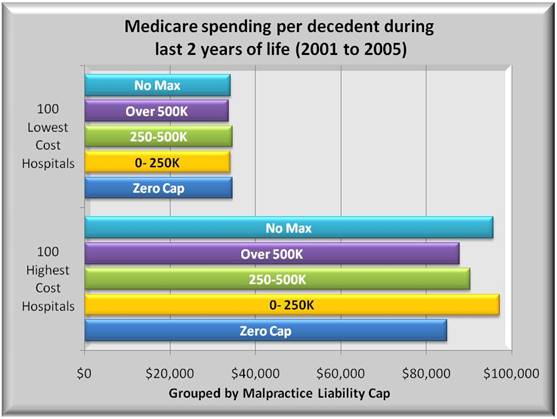
Insurers and others also argue that tort reform would bring down medical costs owing to current waste of defensive medicine. There is no argument about the waste. But is it due to defensive practice or simply practice? Data suggests that the latter is more prevalent.

The graph below, derived from Dartmouth College data, groups two sets of hospitals, the 100 highest cost, and 100 lowest cost hospitals for Medicare spending per decedent during the last two years of life.  The bars represent average costs by states that have enacted tort reform setting caps on non medical damages.  For the lowest cost hospitals, tort reform shows virtually no effect on hospital costs. For the highest cost hospitals, it is mixed. But there is no clear evidence that tort reform will substantially lower costs.

Source: Dartmouth_hosp_DAP_Hosp_HRR_ST_01_05.xls

So far, private insurers’ track record suggests that left to the free market, they will not be very successful in lowering costs, either administrative or medical costs, with or without tort reform.  It may be unrealistic to even expect investor-owned insurers to succeed given that their number one priority is to their investors.

Instead of using their actuaries to data mine patterns to help providers reduce costs, their efforts are focused on denying claims and raising premiums to high claims groups.  Instead of returning surpluses to people paying premiums, they are buying back billions of dollars of their own stock to increase value to their shareholders.

Thus far the focus has been the cost of illness. Another aspect is the benefit of staying healthy. Corporations have had success in wellness programs. They not only reduce health care costs, but lower absenteeism. (http://www.uscorporatewellness.com/USCW White Paper 2009.pdf)  Some insurers offer wellness programs, but they often include a health risk assessment on employees and that runs a risk that insurers may use that data in setting rates for the company: if towards lower rates, good. If higher rates, not so good.

Fortunately, large corporations are the biggest block of insured people, and their wellness efforts can have a broad effect.  The graph below shows the U.S. population by source of health care coverage. Big business covers 45% of the population, 28% who self insure and another 17% who shift risk to insurers.

Source: CBO, EBRI, CMS, Goldman Sachs Research estimates

Groups at a disadvantage to big business include individual and small group business and the uninsured that together make up over a quarter (27%) of the population. If private insurers are unable or unwilling to lower administrative and medical costs for them, then the next best alternative is to offer a Public Option.

Without progress in both lowering administrative and medical costs, the affordability credit paid for by the government is going to cost taxpayers more than can be justified.  The question is not whether a non-profit Public Option will succeed. The question is whether private insurers can succeed after years of failing to take the needed steps to contain costs.

The stakes are huge. CBO projects that with a Public Option, the insurance picture changes dramatically as the graph below shows. Medicaid grows a bit for the poorest, but the uninsured and non employer based population can look forward to more affordable insurance.  Meanwhile the majority of the population is unaffected.

 Source: CBO, Oct 7, 2009 letter to Senator Baucus

Download PDF Report >>> CBO Estimate of Healthcare Reform

Government Bureaucracy?

Download PDF Report >>> Government Bureaucracy

Some people say any Government health plan is a huge bureaucracy. Below are two application forms for personal health insurance. The first is representative of private insurers. The second is from the Government.  Help me out here.  Which one is the bureaucracy?

Private insurer Personal Health Insurance Application Form

8 pages of questions


Government Medicare Personal Health Insurance Application Form

8 questions

Date of Birth:  
Marital Status:  
Type of Medicare Coverage:  
Do you have Medicaid:  
Are you living outside of the U.S.:  
Household Income Range:  
Are you receiving health benefits from employer:  
Retirement type:  

Download PDF Report >>> Government Bureaucracy