Key Healthcare Provisions – Kaiser Foundation

Download PDF Report >>> Key Healthcare Provisions

Kaiser Foundation Source

Some of the items that go into effect in the first year include:

NEW HELP FOR SOME UNINSURED: People with a medical condition that has left them uninsurable may be able to enroll in a new federally subsidized insurance program that is to be established within 90 days. The legislation appropriates $5 billion for this, although that may not be enough to cover all who apply; it’s not clear how much consumers would pay as their share of the cost. About 200,000 people are covered in similar state programs currently, at an estimated cost of $1 billion a year, says Karen Pollitz, a research professor at Georgetown University.

DISCOUNTS AND FREE CARE IN MEDICARE: The approximately 4 million Medicare beneficiaries who hit the so-called “doughnut hole” in the program’s drug plan will get a $250 rebate this year. Next year, their cost of drugs in the coverage gap will go down by 50 percent. Preventive care, such as some types of cancer screening, will be free of co-payments or deductibles starting this year.

COVERAGE OF KIDS: Parents will be allowed to keep their children on their health insurance plan until age 26, unless the child is eligible for coverage through a job. Insurance plans cannot exclude pre-existing medical conditions from coverage for children under age 19, although insurers could still reject those children outright for coverage in the individual market until 2014.

TAX CREDITS FOR BUSINESSES: Businesses with fewer than 25 employees and average wages of less than $50,000 could qualify for a tax credit of up to 35 percent of the cost of their premiums.

CHANGES TO INSURANCE: All existing insurance plans will be barred from imposing lifetime caps on coverage. Restrictions will also be placed on annual limits on coverage. Insurers can no longer cancel insurance retroactively for things other than outright fraud.

GOVERNMENT OVERSIGHT: Insurers must report how much they spend on medical care versus administrative costs, a step that later will be followed by tighter government review of premium increases.

Some of the major changes the reconciliation proposal would make to the Senate-passed bill:

HEFTIER SUBSIDIES: Compared to the Senate legislation, the reconciliation bill would provide more generous subsidies to low- and moderate-income Americans to help them buy health coverage.

THE “MASERATI” TAX: The levy on high-cost insurance plans is scaled back and delayed, rendering it more a “Maserati” than a “Cadillac” tax. It would apply only to the portion of plans costing more than $10,200 a year for individuals, up from $8,500, and $27,500 for families, up from $23,000. The tax wouldn’t kick in until 2018, reducing the projected revenue to the government by 80 percent. Over time, however, the tax would hit more and more plans, because the tax’s threshold is set to increase at the rate of inflation while premiums are expected to continue to grow much more quickly than that.

CLOSING THE DOUGHNUT HOLE: Unlike the Senate bill, the reconciliation measure would eventually close the coverage gap, called the “doughnut hole,” for Medicare beneficiaries enrolled in Part D drug plans. (Currently, seniors who hit the gap must bear the full cost of their medications until they spend a certain amount, when coverage kicks back in.)

Under the new bill, seniors who hit the gap this year would get $250 to help cover the costs of their medications. Starting next year, they’d get a 50 percent discount on brand-name drugs, with the cost borne by the drug industry. In subsequent years, the discounts would expand and begin covering generic drugs, with the expense picked up by the government. By 2020, the discounts would reach 75 percent.

SHIFT IN MEDICARE ADVANTAGE PAYOUTS: Government payments to Medicare Advantage, the private-health plan alternative to traditional Medicare, would be cut back more steeply than under the Senate bill: $132 billion over 10 years, compared to $118 billion.

The government currently pays the private plans an average of 14 percent more than traditional Medicare. The new bill, besides reducing payments overall, would shift the funding; some high-cost areas would be paid 5 percent below traditional Medicare, while some lower-cost areas would be paid 15 percent more than traditional Medicare. The Senate’s plan that would have shielded some areas of the country such as South Florida from major cuts was largely eliminated.

A RAISE FOR DOCTORS: Primary care doctors would get a Medicaid payment boost in the reconciliation bill. Beginning in 2013 and 2014, the doctors’ payment rates would be on par with Medicare rates, which typically are about 20 percent higher than Medicaid. The goal is to ensure that there will be a sufficient number of doctors willing to care for the millions of additional people who would become eligible for Medicaid under the health care overhaul.

PUSHING UP THE MEDICARE TAX: The Senate bill adds a 0.9 percentage point to the Medicare payroll tax on earned income above $200,000 for individuals, or $250,000 for couples. Under the reconciliation bill, starting in 2013, people in those income brackets also would face a 3.8 percent tax on investment income, such as interest, capital gains and dividends.

PENALTY FOR NOT HAVING INSURANCE: Under the new bill, most Americans without insurance would face an annual penalty, starting in 2014 at $95 – the same as in the Senate bill. But in following years, the penalties in the reconciliation bill are slightly different. Those without insurance in 2016, for example, would pay the greater of two alternatives: a flat fee of $695, down from the Senate’s $750, or 2.5 percent of their income, up from 2 percent in the Senate bill.

EXPANDING MEDICAID: The reconciliation package differs from the Senate-passed bill in several ways. It would delete a provision dubbed the “Cornhusker kickback” that would have exempted Nebraska from paying any cost of a Medicaid expansion included in the bill. But it would provide full federal funding to all states for newly eligible Medicaid recipients for three years. And it would give additional funding to states like Vermont and Maine that have already moved to cover adults without children, which isn’t required under the Medicaid program.

MEDICARE SPENDING BOARD: The Senate bill would create an independent, 15-member board to recommend ways to control Medicare spending. The board remains in the reconciliation package, but would be expected to produce just about half of its original projected savings of $23 billion in the Senate bill. That’s because the new proposal would make greater cuts in Medicare Advantage plans.

Download PDF Report >>> Key Healthcare Provisions


Insurers Hide Profitability Behind Return on Sales

Download PDF Report>>> Insurers Hide Profitability Behind Return on Sales

SUMMARY

Health insurance companies have repeatedly claimed their earnings were a very modest 3-5% return on sales. Implicit in their claim is that many others earn far greater returns.  But comparing sales ratios to other industries can be misleading.

High value added industries like software have high sales margins.  Low value added industries like groceries and insurance and have low sales margins. While health insurers may not compare well with the high valued group, they show very fair returns compared with lower added value industries.

Other financial ratios used to compare include ROI and ROE that key not on sales but on gross and net investment. How much money was used to generate profits.  Here the picture is significantly more favorable for health insurers. They are not only near the top of basic industries, but are well positioned compared with more discretionary industries.

RETURN ON SALES

Return on sales, while prevalent, is not the only financial ration used to compare performance.  Each ratio has its strengths and weaknesses.  The weakness of return on sales is that it completely obscures the differences in the value companies add to the goods and services that they sell.

The chart below highlights returns for three industries based on value added. (Ratios are for example only.) The bottom bar represents high value added firms like computer software where purchased goods and services are nominal compared to what they pay their staffs and what they earn on sales.

The mid range covers companies like manufacturers who buy raw materials and intermediate goods, perform significant steps (like conversion and assembly) incurring added costs, and (hopefully) sell at a margin above their internal costs.

Finally, at top are industries where the bulk of their costs are purchased, like groceries and insurance, and while they add value it is small compared to their purchase costs.

In all three cases, a consistent ratio of internal costs of 60% and margin of 40% was applied.  But notice that the margin on final sales (at 100%) ranges from 36% for high value added industries to only 4% for low value added. To rely on returns based on sales is meaningful only within industries with similar value added components.

INDUSTRY COMPARISON OF RETURN ON SALES

Ratios of returns on sales are also influenced by where they stand on a “necessity” scale.  Sales for basic items like food, housing, and utilities, tend to be fairly stable and many of their costs are simply “passed through” to the customer. The more the pass through, the lower the markups tend to be.

Conversely, purchases discretionary purchases for luxuries, entertainment, and cell phones can be expected to have higher margins.  Sales levels are more affected by economic conditions and higher margins compensate for greater risks.

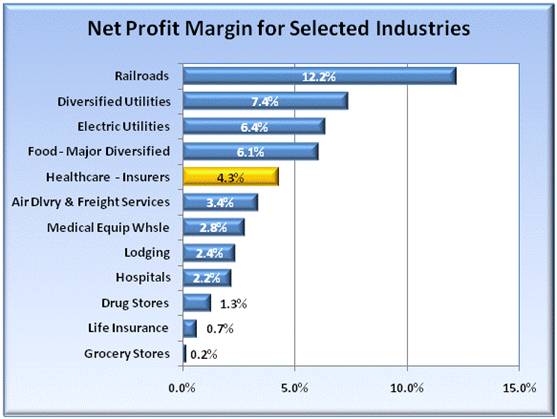
As noted, health insurers act like the poor kid on the block using net profits on sales.  It is true that a group of industries have far better returns than health insurers as shown below. The chart shows returns based on net profit margins divided by sales (Source: Yahoo Finance – Industry Index by Sector).

Insurers ARE the “poor kids on this block.”  But look at the “block.” Cigarettes, beer, wine and liquor, golf clubs and perfume, cell phones and cable TV.  These industries can hardly be defined as meeting basic customer needs.  These are discretionary purchases that can cut back on during tough times.  Purchases of basic necessities are harder to cut back.

Below is a different group of industries covering more basic needs. One would reasonably assume that health insurance is a basic industry and where value added is small compared to total costs.  While Health Insurers (gold bar) may not be the highest in this group either, they are by no means the lowest.  What you don’t see are these other industries complaining about their low returns on sales as health insurers do.

OTHER FINANCIAL RATIOS:  ROI/ROA AND ROE

With wide swings in returns based on sales revenue, Wall Street uses several other ratios to compare rates of return. One is return on investment (ROI).  Buy a CD and earn 2.5%.  It’s simple.  ROI = 2.5%.  Now buy a house. Pay cash and it’s just like a CD.  But if you take out a mortgage, you have leveraged your returns.  Your house will change value the same regardless of how much equity you have invested. But your Return on equity investment (ROE) is different.

The chart below shows how this works. Assume you buy a house and take out a mortgage for 60% of the purchase. A number of years later, you sell the house for 20% more than you paid.  If you had paid cash, your return would be 20%. But if you had mortgaged 60%, you put up only 40% cash and your return is a 50% (20% return /40% cash invested). ROE is similar to return on investment (ROI) or assets (ROA) but reflects only the net amount of equity investment.

INDUSTRY COMPARISON OF RETURN ON EQUITY

Previously described were two groups of industries, those dealing in basic necessities, and those more in discretionary items.  The groups are the same but comparison is different, using the return on equity (ROE) ratio as just described.

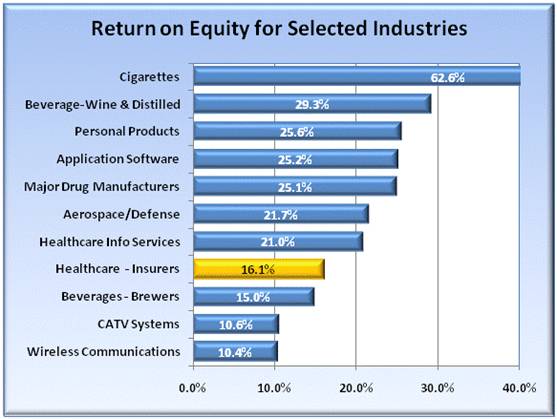
Again we begin with the discretionary group where health insurers fared poorly.  Using ROE ratios, health insurers rose in rank, passing up beer, cable TV and cell phones.  Again, one has to ask whether anyone should be comparing the service provided by health insurers to be in this “block.”

Wall Street considers returns on equities in the 15-16% to be normal average for all industries. But again the question is whether health insurers should be considered “average” when they satisfy basic needs where lower ROE’s are expected.

Comparing health insurers with the same group of basic industries shown previously, the picture below dramatically changes.  Insurers are near the top of the group with the majority of industries coming in lower.  These industries are more suitable comparisons than insurers prefer to use.

One final observation.  Health insurance used to be heavily non-profit. For profit insurers came later as life insurance companies began to diversify into more profitable fields.  Now look at the ROE for life insurance: at the bottom.

Download PDF Report>>> Insurers Hide Profitability Behind Return on Sales

Fact Check: Provider Consolidation Driving Up Costs

Download PDF Report >>> Fact Check – profits and consolidation

Fact Check:  Provider Consolidation Driving Up Costs

  • · Massachusetts Attorney General issued a report that: “points to the market clout of the best-paid providers as a main driver of the state’s spiraling health care costs” and “found no evidence that the higher pay was a reward for better quality work or for treating sicker patients”.
  • · According to a new report in Health Affairs, Paul Ginsburg and Robert Berenson found that “providers’ growing market power to negotiate higher payment rates from private insurers is the ‘elephant in the room’ that is rarely mentioned.”
  • · According to a brief from the National Institute for Health Care Management: “With only a few exceptions, results consistently demonstrate that hospital consolidations result in higher prices for hospital services.”
  • · The Federal Trade Commission and the Depart­ment of Justice noted: “Most studies of the relation­ship between competition and hospital prices have found that high hospital concentration is associated with increased prices, regardless of whether the hospitals are for-profit or nonprofit.”

FACT CHECK CHECKED: The above are arguments that America’s Health Insurance Plans (AHIP) included in their response to advocates of reform. What AHIP may not recognize is it has set forth some of the most compelling arguments for a “public option”.

AHIP freely admits that insurers are powerless on their own to control provider costs. Even with anti-trust exemptions, they have failed to combine forces and confront providers.  Short of a government takeover, the only long-term solution is more clout.  The only entity with more clout is the government itself being an insurer, which, by the way, it already is – Medicare.

Medicare doesn’t so much “ask” providers what they charge.  Medicare almost “tells” providers what it will pay. Republicans were so concerned with Medicare’s clout that they wrote into law “prohibiting” negotiated drug discounts.  But discounts will become necessary.

For many Americans, a drastically reformed healthcare system was a non-starter.  The administration politically tried to blend features of the current into the proposed system to reduce upheaval to such a large part of the economy.  Any change can be unsettling, and how you view it is very important.  Is the glass half full or half empty?  At some point, radical cost control will occur, and private insurers will not be leading the charge.

Insurers can look on government as an unreasonable competitor or they can look on government as the only insurer who finally has enough clout to contain provider costs.  It may be that insurers eventually withdraw from the market for “essential medical benefits” and focus their efforts on supplemental policies that go beyond basic.  If they did, they would look a lot like health insurers in Europe and other industrialized countries. Diminished compared to today but not destroyed.

Download PDF Report >>> Fact Check – profits and consolidation

Fact Check: Put health plan profits in perspective

Download PDF Report >>> Fact Check – profits and consolidation

Fact Check:  Put health plan profits in perspective

  • Ezra Klein, Washington Post:… it’s hard to see how [health plan profit margins] are a primary driver of health-care spending, much less the growth in health-care spending.”
  • Henry Aaron, Brookings Institute: “Insurance company profits in the large picture have very little to do with the overall rising cost of health care.”
  • Kaiser Health:“With the nation’s health care spending estimated at $2.5 trillion this year, even the elimination of insurers’ profits and executive compen­sation would lower health care spending by just 0.5 percent.”

FACT CHECK CHECKED: Granted, the insurers cut is a miniscule piece of total costs.  But it is still billions of dollars of non medical costs.  Where are they spending them?  It should be in two areas: to responsibly manage insurance and contain costs. If insurers were managing just fine, reforms would not include rule after rule after rule to rein in unsavory practices that occur now.

Cost containment has two faces: price and volume. You can control one or both. Insurers can control volume by denying claims, and here they have been successful.  In the price area, they have utterly failed to contain prices from providers. But Wall Street is indifferent in how one generates earnings, only that one does.  Clearly, insurers’ focus is Wall Street and not Main Street.

Insurers claim they add value by negotiating discounts with providers.  But by insurers’ own admission, those providers simply raise their rates resulting in no actual cost reductions.  Insurers are adding virtually no value, but draw compensation as if they were saving billions.

All large companies pay cost control experts to contain costs. If they fail, the experts are fired or the companies go out of business. Yet insurers exert every conceivable pressure to maintain the status quo which they admit has been a failure in containing healthcare costs.

Download PDF Report >>> Fact Check – profits and consolidation

Fact Check: Lines of Business Obscure Profit Margins

Download PDF Report >>> Lines of Business Obscure Profit Margins

FACT CHECK: In 2009, the percentage of premiums that went towards administrative costs and profits declined for the sixth year in a row and have been consistent for decades.

FACT CHECK CHECKED: America’s Health Insurance Plans (AHIP) combines self-insured line of business (LOB) and insured LOB and presents the results as if it were one homogeneous market.   Nothing could be further from the truth. Size wise, the ratio of self insured LOB to insured LOB is roughly 58% / 42% of self-insured / insured or underwritten.

Insurers charge self-insured (ASO – administrative service only) groups an administrative fee that, for the top 10 health insurers, averaged 6.94% of costs.  That translates to 6.5% of “premiums” which are really medical benefits plus service fee income.  This “efficient” administrative expense is not evident in the insured LOB.

To identify the administrative costs and profits for the insured group, one computes and then removes the self-insured revenues and expenses from the CMS Totals as shown in the table below.  Sources and stepwise methodology (top to bottom) are shown in the far right column.

The claim that insurers’ average percentage of premiums that went towards administrative costs and profits was around 11.75% (and have been consistent for decades) totally obscures two radically different lines of business with divergent expense ratios.   For 2008, self-insured admin costs and profits were about 6.5% for self-insured groups, but about 18% for insured groups.  Since the profit margin is VERY slim for the self insured, the bulk of profits are born on the backs of the insured groups which include small business and individuals. A reasonable question to ask is “why are insurers satisfied with profit margins of well under 1% on 55 % of their business but feel a need to push margins well beyond 10% on 45% of their business?”  Though risk is a small factor in the insured LOB, they have to compete far harder on self-insured LOB than on insured LOB where they hold oligopoly power in local market areas and convert that market power into profits.

Download PDF Report >>> Lines of Business Obscure Profit Margins

Senate Gridlock – the Filibuster Factor

This Analysis has been replaced with a new version: Senate Filibusters Reveal Deliberate Obstruction


Health Care Reform: Separating the Wheat from the Chaff

Download PDF Report >>> Healthcare Reform Pro-n-Con

By Andrew Kurz* and Miles J. Zaremski**


It is time to hit the reset button—not on legislation—but on all the disparaging rhetoric surrounding it.  Denigrating a position or viewpoint one knows nothing about or is premised on incorrect “facts” makes it harder to adopt positions that best serve what Americans need and really want.  It is also more difficult to garner broad support from the general public if one succumbs to only what special interests desire.

The shot across the bow sent Democrats by the voters of Massachusetts with the election of Scott Brown can have many meanings, but one in particular has to be striking: politicians in Washington are not getting things done to help us outside the beltway.  A clear message from the Massachusetts’ electorate was that it is just as easy to remove an elected-official, as it was to vote that individual into office.

Americans are rightly upset with Washington, and certainly with good reason—particularly with health care reform, and other major pieces of legislation.  So little gets done, and when something is finally accomplished, it generally contains much unneeded and unnecessary pork.

We are here to focus strictly on explaining health care reform issues that make sense to all parties.  The focus is not on the current state of legislation, on Congress, or on the President.  We begin with the premise that accessing and affording health care in this country is truly broken.  On that, there is universal agreement.  Most would also agree that basic health care is a right for all Americans, not a privilege or responsibility—although a measure of personal responsibility is certainly involved. The authors also have the luxury of being “outsiders” and are not otherwise bound by having to politically compromise.   We can look at the best of what both sides of the aisle have offered that every American can readily understand and assimilate into their own experiences and household needs.

We offer a couple of other observations before we do.  Of the 2,000 pages in either the present House or Senate bills, less than 20% of them are concerned with much discussed reforms to private health insurance.  The remaining portions improve Medicare and Medicaid, and as well public health and the workforce.  Those changes are extremely important to bending down the cost curve for a segment that consumes about 50% of all health care dollars.  Ironically, for those who believe that reform is socialism, these programs are already government managed or sponsored.

Health care is cast in terms of affordability and accessibility.   Affordability is typically cast through the prism of a health insurance policy since that is how and where the majority of Americans receive their care.  Main Street also knows that what they pay for insurance is out of sight—sending thousands into bankruptcy, and, for millions, effectively denying them any insurance coverage at all.  For the overriding majority of the uninsured, insurance premiums either would consume far too much of their income, or they are locked out because of some pre-existing condition.  So health care reform, at least for starters, is health insurance reform.

Insurance reform has three fundamental goals or objectives: lowering costs, increasing availability, and maintaining or improving quality.  While there is wide agreement on these goals, there remains less agreement on how to achieve them.  When reviewing the paths to achieve each of these “end points”, the question is, whether they lead to progress toward achieving them (goals) or whether the means to get there are simply different paths with no discernible difference in outcome.  The strength of any analysis must focus on the former, as we now do.

ISSUES ON WHICH THERE IS BROAD AGREEMENT

The following objectives of which we speak have no adversary, though politics has a habit of tinting some folks’ glasses.

1. Accessibility: Broad agreement exists that insurance policies should (a) not exclude pre-existing conditions; (b) not allow cancellation of an existing policy owing to a medical condition; (c) guarantee issuance and renewals; (d) extend dependent child coverage to 26 years; and (e) allow cancellation only premised on non-payment of premium or fraud in the procurement of a policy.

2. Affordability:  Broad agreement also exists that insurance policies should (a) not set lifetime or annual limits on benefits; (b) set reasonable annual limits for cost sharing, i.e., deductibles and co-pays; (c) not allow pricing differentials based on sex; (d) set reasonable restraints on age-related differentials; and (e) create a national high risk reinsurance pool to protect insurers from the few enrollees who incur extremely high cost medical treatments.

(3) Quality:  Broad agreement also exists that insurance policies should (a) not require cost-sharing for basic, preventive health care services, though not necessarily for visits beyond recommended check-up intervals; (b) require an essential benefits package that covers all basic health care needs and allows comparison based only on price and service; (c) standardize forms in order to reduce paperwork and inefficiency in processing claims and enrollment; and (d) further the work of computerizing necessary medical information without running afoul of privacy laws.

Virtually every other industrialized country worldwide has health care inclusive of the above provisions.   These nations also provide universal coverage, exceeding the 95% range.  While all such programs operate differently, all have a private marketplace component and deliver health care at half the cost and with about the same average quality as the U.S.   Moreover, while the U.S. leads other nations in some criteria used to judge access and affordability, it lags in other criteria.  One measure where our country lags is the number of patient visits.  Our falling down on this measurement is oxymoronic to the claim that the US has the best health care system while citizens elsewhere wait an interminable amount of time to see his or her physician.

ACCESSIBILITY ISSUES ON WHICH THERE IS LESS AGREEMENT

While Medicare at 55 has been proposed to increase accessibility, the three major avenues to increase accessibility have been: (1) a public option; (2) lifting the antitrust exemption; and (3) allowing insurers to sell health insurance across state lines.   We address the latter three now.

PUBLIC OPTION: Arguments favoring a public option are that it would be a non-profit insurer with the sole goal of providing basic insurance while incurring minimum overhead.  This should bend prices down which also improves affordability.  Arguments against a public option are that it adds government insurance into the mix, pulling business and profit margins away from private insurers.  It is fair to note that private insurers did not object to government insurance for seniors – Medicare –which took the lion’s share from private insurers, though the private market still operates within segments of these programs.

ANTI-TRUST: The second method for increasing access through competition is to remove private insurers’ anti-trust exemption.  This exemption allows insurers to not only collude on setting premium prices, but also to monopolize markets of whatever size.   Both promote concentration, less competition, and higher prices.

SALES ACROSS STATE LINES: The third method is for insurers to sell across state lines. There are two ways to achieve this.  The first alternative is leveling the playing field with a uniform set of rules that a national exchange would establish, similar to what CAFE mileage standards do for car manufacturers when mandating “corporate average fuel economy” that apply in all states.  A national exchange is the health equivalent for enforcing uniform standard rules.  The other alternative is to use the credit card “model”, where different rules apply to different policies depending upon the insurer’s home state.  The question becomes, would the public prefer insurers to act more like credit card companies (banks) with no federal intervention, or to participate on a level playing field with federal enforcement?

AFFORDABILITY ISSUES ON WHICH THERE IS LESS AGREEMENT

TORT REFORM: High on the list for many is tort reform, though neither pending bill in Congress includes this.  Typically cast in terms of placing caps, or ceilings, on non-economic damages, it is an element of the health care reform debate that has gained attention in many quarters.  Many states already have such reform, but this would be a federal cap.  The argument in favor of caps on these damages is that there would be less defensive-medicine, overall health care costs would drop significantly, and doctors would find their malpractice insurance premiums lowered. The argument against caps is that there is minimal relationship between caps on these type damages and premium charges, or health care costs.  Opponents argue that premiums increase more as a result of insurers’ not obtaining projected financial returns from investments while “defensive medicine” has more to do with generating income than avoiding liability.

If the theory is correct, viz, that a cap on damages will reduce health care costs, consider establishing a 3-5 year period with a federal cap of, let’s say, $1.0M on non-economic damages and that would not pre-empt states which have such ceilings in effect.  If utilization drops significantly indicating less defensive medicine, then such caps could become permanent; it not, then the federal cap would sunset.

AFFORDABILITY CREDITS: Affordability credits are a sliding scale subsidy for individuals and families earning less than some multiple of the federal poverty level (FPL).  The House suggested an upper limit of 400% of FPL while the Senate proposed less.  To fund affordability credits (the premium subsidies), a tax could be levied on individuals with adjusted gross income exceeding $250K ($500K for families), and taxing plans with “Cadillac” benefits.  Rather than setting a flat rate, a fairer method would be to use regional cost bases, and to tax only the amount exceeding some percent of average, basic, benefits by region.  Arguments for and against affordability credits tend to center on the method of funding.  The two above are funding options under consideration.

PURCHASE MANDATE: This provision mandates that all citizens purchase health insurance.  Arguments in favor are that by adding millions of customers, insurers would incur lower costs.  First, overhead would be allocated over more policies creating unit savings.  Second, with larger risk pools, the “risk margin” insurers require would be less, which should lead to lower premium prices.  Mandatory insurance would also have the salutary effect of reducing the number of those without insurance who rely on hospital emergency rooms for non-emergency health care—a very inefficient way to render treatment.  Arguments against mandatory purchase includes whether such a requirement is constitutional, though it seems similar to employees “purchase” of Medicare insurance through wage withholding at work.  Those who do not favor a mandate as well point to insurers’ gaining considerably in revenues, yet question whether or not insurers will increase premiums for any new insurance reforms, like no pre-existing condition barring coverage.

The only way a mandate works is if affordability credits are extended to millions of financially disadvantaged.  Those affordability credits will come from government subsidies, and because taxpayers are responsible for these monies, many believe it fair to expect insurers to discount, or reduce, premium charges when setting rates.  Insurers are not likely to do this voluntarily.  Price controls are one way to restrain premium rates, but are not viewed as a long term solution.  The best solution remains competition.  This is why many argue that the anti-trust exemption must end, though they feel even that may not be enough; that stronger measures are needed.  The current mix of for-profit and not-for-profit insurers has not been successful in restraining prices, and a government backed not-for-profit is needed.  This thinking is the impetus behind advocating for a strong public option.

DISCOUNTED DRUGS: The final affordability issue would be to allow Medicare to negotiate drug discounts and to allow cross-border purchases.  Arguments against discounting are that margins are needed for research into new drugs and that the quality of imported drugs cannot be assured.  Arguments in favor of discounts are similar to the purchase mandate.  The government handed big pharmaceutical companies $Billions of new business with no risk.  Many feel that the pharmaceutical industry should be forced to accept “discounts”.  The current no discount policy has resulted in U.S. drug prices far above what pharmaceuticals cost in other industrialized countries.  As for quality, many of the drugs purchased here are the very same pharmaceuticals that buyers in other industrialized countries purchase.  Recall, too, that the Medicare drug program costing hundreds of billions of dollars was not funded, with the entire cost of the program being added to the federal deficit.

INTERIM CONSUMER PROTECTIONS WHILE REFORMS ARE IMPLEMENTED

Many of the above provisions cannot be implemented quickly.  Some method is needed to restrain premium increases in the interim.  To prevent health insurers from imitating credit card companies who increased rates before reforms became effective, a gatekeeper, whether through a national commission, state insurance commissions, percent increases imposed by statute, or another mechanism, ought to be in place from the outset of any reform enacted into law.

CONCLUSION

In less than ten pages, we have summarized the salient components of 2010 health care reform.  What we have penned allows the reader to understand the core provisions for any reform, pro and con.   Moreover, the material described in the foregoing pages is a give and take where no one constituency will be entirely happy.  But in order for every American to afford and access health care, each segment of our society must give up something that may have been sacrosanct to them.  Such compromising also levels the playing field between corporate and Main Street America.   If every “player” comes to the table called health care reform in good faith and acts fairly and openly, the nation as a whole will benefit.  Partisanship only leads to what occurred in Massachusetts; we cannot afford to see this with efforts to reform health care any longer—our system is broken and on the brink of disaster.

© 2010 Andrew Kurz and Miles Zaremski

*   Mr. Kurz is a former CFO for Blue Cross-Blue Shield of Wisconsin.  He has done extensive research into healthcare reform and has been recognized and quoted for his analyses, statistical charts, and insights into reform efforts.  He is now retired in suburban Chicago and can be reached at agkurz@att.net.

** Mr. Zaremski is a health care attorney and author, with extensive background in healthcare policy.  He has counseled and represented Members of Congress.  His law firm is in Northbrook, Illinois; he can be reached at mzaremski@gmail.com.

Download PDF Report >>> Healthcare Reform Pro-n-Con

Summary – Health Care Reform: Separating Wheat from Chaff

Download PDF Report >>> Healthcare Reform Pro-n-Con Smry

Insurance reform has three fundamental goals:

  1. lowering costs,
  2. increasing availability,
  3. maintaining or improving quality.

When reviewing the paths to these “end points” of healthcare reform, the question is, whether they progress toward achieving them (goals) or whether the means to get there are simply different paths with no discernible difference in outcome.

ISSUES ON WHICH THERE IS BROAD AGREEMENT

ACCESSIBILITY:  Insurance policies should (a) not exclude pre-existing conditions; (b) not allow cancellation of an existing policy; (c) guarantee issuance and renewals; (d) extend dependent child coverage to 26 years.

AFFORDABILITY:  Insurance policies should (a) not set lifetime or annual limits on benefits; (b) set reasonable annual limits for deductibles and co-pays; (c) not allow price differentials based on sex; (d) set reasonable restraints on age-related differentials; and (e) create a national high risk reinsurance pool to protect insurers from enrollees who incur extremely high cost medical treatments.

QUALITY:  Insurance policies should (a) not require cost-sharing for basic, preventive health care services; (b) require an essential benefits package that covers all basic health care needs; (c) standardize forms to reduce inefficiency in processing claims and enrollment; and (d) further computerizing medical information.

ISSUES ON WHICH THERE IS LESS AGREEMENT

PUBLIC OPTION: Arguments in favor are that a government non-profit insurer would provide basic insurance with less overhead.  Arguments against are that it adds government insurance into the mix, pulling business and profit margins away from private insurers.  Note: private insurers did not object to government Medicare for seniors which took the lion’s share from private insurers.

ANTI-TRUST: Removing private insurers’ anti-trust exemption increases competition.  Exemptions allow insurers to not only collude on setting premium prices, but also to monopolize markets resulting in higher prices.

SALES ACROSS STATE LINES: There are two ways to sell.  The first is leveling the playing field with a uniform set of rules similar to what CAFE mileage standards do for car manufacturers when mandating “corporate average fuel economy” that apply in all states.  A national exchange is the health equivalent for enforcing uniform standard rules.  The other alternative is to use the credit card “model”, where different rules apply depending upon the insurer’s home state.  The question becomes, would the public prefer insurers to act more like credit card companies (banks) with no federal intervention, or to participate on a level playing field with federal enforcement?

TORT REFORM: Many states already have such reform; this would be a federal cap on non-economic damages.  The argument in favor is there would be less defensive-medicine and overall health care costs would drop significantly.  The argument against is there is minimal relationship between caps and health care costs; that “defensive medicine” has more to do with generating income than avoiding liability.

AFFORDABILITY CREDITS: Affordability credits are a sliding scale subsidy for individuals and families earning less than some multiple of the federal poverty level (FPL).  To fund affordability credits (subsidies), a tax could be levied on individuals with adjusted gross income exceeding $250K ($500K for families), and taxing plans with Cadillac benefits.  Arguments for and against tend to center on the method of funding.

PURCHASE MANDATE: This mandates that all citizens purchase health insurance.  Arguments in favor are that by adding millions of customers, insurers would incur lower average costs.   Mandatory insurance would also have the salutary effect of reducing the number of those without insurance who rely on hospital emergency rooms for non-emergency health care—a very inefficient way to render treatment.  Arguments against include whether such a requirement is constitutional, though it seems similar to Medicare insurance through withholding work; and whether or not insurers will increase premiums for new insurance reforms, like no pre-existing condition barring coverage.

The only way a mandate works is if affordability credits are extended to millions of financially disadvantaged.  Affordability credits will come from government subsidies, and because taxpayers are responsible for these monies, many believe it fair to expect insurers to discount, or reduce, premium charges when setting rates.

MANDATE EXPECTS LOWER PRICES: Insurers are not likely to do this voluntarily.  Price controls are one way to restrain premium rates, but are not viewed as a long term solution.  The current mix of for-profit and not-for-profit insurers has also not been successful in restraining prices.  The best solution remains more competition, and is the impetus behind those advocating a strong public option.

DISCOUNTED DRUGS:  Allow Medicare to negotiate drug discounts and cross-border purchases.  Arguments against are that margins are needed for research into new drugs and that the quality of imported drugs cannot be assured.  Arguments in favor are that the current no discount policy has resulted in U.S. drug prices far above what prescription drugs cost in other industrialized countries.  As for quality, many of the drugs purchased here are the very same that buyers in other industrialized countries purchase.

© 2009 Andrew Kurz and Miles Zaremski

Download PDF Report >>> Healthcare Reform Pro-n-Con Smry

World Quality Compare

Download PDF Report >>> World Quality Compare

Summary

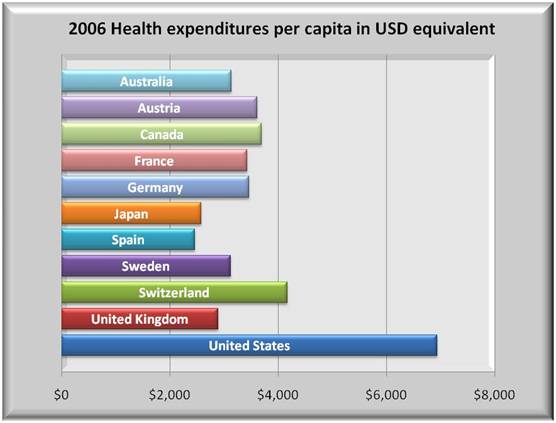
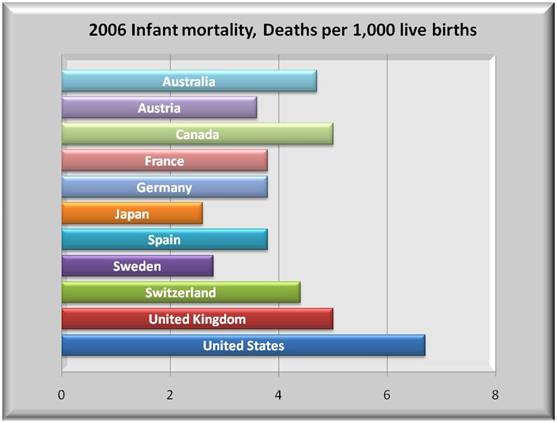
A summary glance at the graphs below should serve notice to all that the U.S. healthcare is in crisis. The left graphs show 2006 health spending both as a percent of GDP and on a per capita basis to be far above all other nations in the OECD (Organization for Economic Co-operation and Development).

And if that wasn’t bad enough, the graphs on the right show that the trend is so bad compared to these OECD countries that without a major policy change, the U.S. will be paying far more into health care and far less in productive activities compared to its competitor nations.  That all were similar years ago suggests that a U.S. solution is possible.

Yet, for all these higher costs, is the U.S. really getting better health care than other OECD countries?  Graphs show only selected countries, but data include all 30 nations.  The U.S. more often than not compares unfavorably in key areas.

All data in this report are derived from OECD Health Data 2009 – Version: June 09 .  Below each graph are all nations’ computed average, the percent the U.S. is over or under that average, and the min and max for those criteria.

Of the areas selected, the U.S. is significantly above average in % of GDP spend, health care and prescription drug costs per capita, MRI units, CT scanners, and infant mortality.

The U.S. is significantly below average in acute care beds, doctor’s consultations and hospital discharge rates per capita, in average length of stay in acute care hospitals, and in population over 15 years old who smoke.

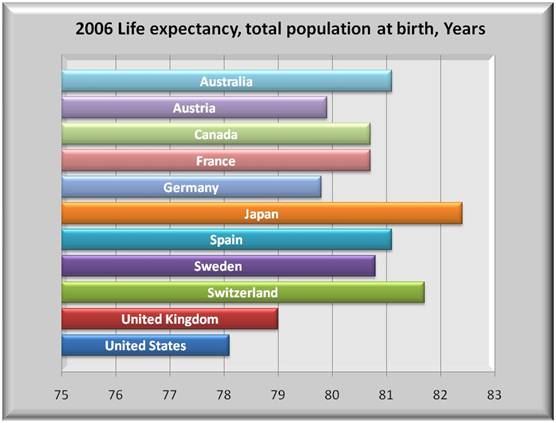
The U.S. is about average in life expectancy at birth but lags key European countries.  It is average in cancer death rate. There are other factors that are not part of the OECD report, but the issue is whether the U.S. is getting its money’s worth.

Average: 8.9%    U.S. vs. Average: 78%    Minimum: 5.8%    Maximum: 15.8%.

The U.S. clearly pays the highest percent of its GDP for health care.

Average: 8.9%    U.S. vs. Average: 78%    Minimum: 5.8%    Maximum: 15.8%.

The trend of OECD countries is clearly lower than for the U.S.

Average: $3,073    U.S. vs. Average: 126%    Minimum: $1,322    Maximum: $6,933.

The U.S. clearly pays the highest per capita cost for health care.

Average: $3,073    U.S. vs. Average: 126%    Minimum: $1,322    Maximum: $6,933.

The trend of OECD countries is clearly lower than for the U.S.

Average: 72.9%    U.S. vs. Average: -38%   Minimum: 44.2%   Maximum: 90.9%

There is still a large percent of private health participation in OECD nations.

Average: $451    U.S. vs Average: 87%   Minimum: $178    Maximum: $844

The U.S. pays almost double per capita for its drugs versus the OECD.

Average: 3.9    U.S. vs. Average: -31%    Minimum: 1    Maximum: 8.2

While the U.S. is comparable to some nations, it lags behind some key nations.

Average: 9.7    U.S. vs. Average: 173%    Minimum: 1.4    Maximum: 40.1.

Except for Japan, the U.S. has more than twice as many MRI’s as other nations.

Average: 21.7    U.S. vs. Average: +57%    Minimum: 3.4    Maximum: 92.6.

Not quite as extreme as MRI units, but the US is still out front of EU countries.

Average: 6.7    U.S. vs. Average: -43%   Minimum: 2.8   Maximum: 13.6.

Access to care in other countries?  They are far ahead of the U.S. in this category.

Average: 16,256    U.S. vs. Average: -22%   Minimum: 5,486   Maximum: 28,440.

If you do not admit, there is no discharge.  U.S. is moving to outpatient.

Average: 6.9    U.S. vs. Average: -19%    Minimum: 3.9    Maximum: 19.2.

But for those needing acute care, the U.S. is about average for other than Japan.

Average: 79    U.S. vs. Average: -1%    Minimum: 71.6    Maximum: 82.4.

Considered a health quality factor, the U.S. lags behind key countries.

Average: 5.1    U.S. vs. Average: +31%    Minimum: 1.4    Maximum: 22.3.

The U.S. clearly lags in this health quality measure.

Average: 164.5    U.S. vs. Average: -4%    Minimum: 96.5    Maximum: 219.8

With cancer the leading cause of death, the U.S. is still only average.

Average: 24.4%    U.S. vs. Average: -34%    Minimum: 14.5%    Maximum: 40%.

Despite more smokers in Europe, they still have longer life expectancies.

APPENDIX

The following tables offer a complete list of data available.  Those highlighted are included above.

OECD Health Data 2009 – Frequently Requested Data

Health expenditure

–         Total expenditure on health, % of gross domestic product

–         Total health expenditure per capita, US$ PPP

–         Public expenditure on health, % total expenditure on health

–         Pharmaceutical expenditure, % total expenditure on health

–         Pharmaceutical expenditure per capita, US$ PPP

Health care resources

–         Practising physicians, density per 1 000 population

–         Practising nurses, density per 1 000 population

–         Medical graduates, density per 1 000 practising physicians

–         Nursing graduates, density per 1 000 practising nurses

–         Hospital beds, density per 1 000 population

–         Acute care beds, density per 1 000 population

–         Psychiatric care beds, per 1 000 population

–         MRI units per million population

–         CT Scanners per million population

–         Mammographs per million population

–         Radiation therapy equipment per million population

Health care activities

–         Doctor consultations per capita

–         Hospital discharge rates, all causes, per 100 000 population

–         Average length of stay for acute care, all conditions, days

–         Coronary artery bypass grafts (CABG), per 100 000 population

–         Coronary angioplasties, per 100 000 population

–         Caesarean sections, per 100 live births

Health status (Mortality)

–         Life expectancy at birth, females, males and total population

–         Life expectancy at 65 years old, females and males

–         Infant mortality rate, deaths per 1 000 live births

–         Potential years of life lost (PYLL), all causes females and males

Suicides, deaths per 100 000 population

Download PDF Report >>> World Quality Compare

Healthcare Bill – Initial Reforms

Download PDF Report >>> Healthcare bill-Senate initial reforms

SUMMARY

This article was written before final passage of the bill.  The provisions noted here are all in the final bill.  Like all legislation compromises find their way into the Senate bill.  Nevertheless, there are still many good reforms that deserve passage of the bill. Below are nine good reasons that occur just in 2010 to justify passage.

DISCUSSION

Howard Dean suggested senators reject the current form of the senate bill as not offering an alternative to private insurance and thus, unable to control costs.

One senator disagreed saying that while we wanted to build a nice house, all we can afford is a cottage.  But that cottage has a very solid foundation.  In time, we can make additions, but if we do not have a foundation, no additions or changes will even be possible.

This article addresses just a few foundation items that take effect early in the program.  Though one should not stop pressing for greater reform, not passing any bill would have even greater adverse consequences.

The following page lists excerpts from the senate bill as published earlier.  The comments below hopefully “translate” some of that legalese into layman’s language for the rest of us.  Hopefully, they provide encouragement to continue to press for better and better reform, but not to throw the baby out with the bath water if it seems reform does not go far enough. Below are nine good reasons that occur just in 2010 to justify passage

Actions Effective when Reform Bill is Enacted

  1. Section 1003 establishes in each state a process for review of unreasonable premium increases, approval of increases, and disclosure by insurers of justifications for their increases.  While this does not lower rates, it should constrain unreasonable increases and create transparency. Insurers are open to embarrassment if they press for extreme increases.  This section further provides a $250 million fund to the states to enforce this provision and give it some teeth.

Actions Effective within 90 Days of Enactment

  1. Section 1101 provides creation of a high risk pool for immediate access by uninsured with preexisting conditions. It requires enrollees to pay only “normal” premiums with cost deficits covered by a $5 billion appropriation.  It also includes an anti dumping clause to prevent plans from discouraging anyone from remaining enrolled. In effect, neither insurers nor companies could offload their high cost persons onto this subsidized high risk pool.
  2. Section 1102 effectively extends COBRA coverage for “retired” employees ages 55 and older. To protect employers extending COBRA, it provides them a reinsurance plan whereby if a retiree’s claims exceed $15,000, the government will reimburse the employer 80% of costs in excess of the $15,000.

Actions Effective within 6 Months of Enactment

Section 1001 contains 6 key subsections that are not practical to enforce immediately but are too important to delay for a whole year.

  1. Sec. 2711 prohibits insurers from setting lifetime or unreasonable annual dollar value limits on what they will pay under a plan
  2. Sec. 2712 prohibits insurers from rescinding coverage once an enrollee is covered under a plan
  3. Sec. 2713 prohibits insurers from imposing cost sharing (deductibles or copayments) for preventative services, immunizations, and preventative services for young children
  4. Sec. 2714 extends coverage of dependent unmarried children until age 26
  5. Sec. 2715 requires Uniform Explanation of Coverage Documents and Standard Definitions.

(a)    Establish strict disclosure rules including limiting documents to 4 pages of 12 point font (no fine print), understandable language, and clear benefits description and cost.

(b)    Preempt states with lower standards

  1. Sec. 2718 is designed to bring down costs

(a)    Establish accounting rules that standardize and segregate medical claims and  non-medical costs

(b)    Set minimum MLRs (according to rules in (a).  MLRs are already in the legislation, though their levels are similar to today’s actual MLRs (85% for groups, 80% for individuals).  Excess margins would be rebated to customers. MLRs could be made more stringent in the Senate-House reconciliation.

(c)    Require hospitals to “establish and make a list” of standard charges. The provision removes some of the secrecy and multiplicity in hospital pricing. By making them public, people can make more informed decisions about costs.

Subtitle A — Immediate Improvements in Health Care Coverage for All Americans

Sec. 1001. Amendments to the Public Health Service Act. (effective 6 months after enactment)

  • Sec. 2711. No Lifetime or Annual Limits.

Insurers may not establish—(1) lifetime limits on the dollar value of benefits for any participant or beneficiary; or (2) unreasonable annual limits

  • Sec. 2712. Prohibition on Rescissions.

Insurers shall not rescind such plan or coverage with respect to an enrollee once the enrollee is covered under such plan or coverage involved

  • Sec. 2713. Coverage of Preventive Health Services.

Insurance coverage shall provide coverage for and shall not impose any cost sharing requirements for—Preventative services, Immunizations, and preventative care for infant, children and adolescents

  • Sec. 2714. Extension of Dependent Coverage.

Policies covering dependent coverage of children shall continue to make such coverage available for an adult child (unmarried) until the child turns 26 years of age

  • Sec. 2715. Development and Utilization of Uniform Explanation of Coverage Documents of Standardized Definitions.

SUBSECTION (a) In GeneralNot later than 12 months after the date of enactment … develop standards … in compiling and providing to enrollees a summary of benefits and coverage explanation that accurately describes the benefits and coverage under the applicable plan or coverage.  The standards include:

  1. Appearance – not more than 4 pages
  2. Language –utilizes terminology understandable to an average enrollee
  3. Contents – must include:
    1. Uniform definitions so customers may compare
    2. Description of coverage including cost sharing for –Each category of benefit

1)      Exceptions, reductions, limitations

2)      deductible & co-payments

3)      Continuation provisions

4)      Examples to illustrate common benefits

SUBSECTION (e) PREEMPTION.—The standards developed under subsection (a) shall preempt any related State standards that require a summary of benefits and coverage that provides less information to consumers

  • Sec. 2718. Bringing Down the Cost of Health Care Coverage

a)      Clear accounting for Costs – annual report concerning the percentage of total premium revenue that such coverage expends—

1)      on reimbursement for clinical services provided to enrollees under such coverage;

2)      for activities that improve health care quality; and

3)      on all other non-claims costs, including an explanation of the nature of such costs, and excluding State taxes and licensing or regulatory fees.

b)      Ensuring That Consumers Receive Value for Their Premium Payments.— Requirement To Provide Value For Premium Payments.—rebate to each enrolled amount exceeding

  1. Group market – 20%
  2. Individual market – 25%

c)      STANDARD HOSPITAL CHARGES.—Each hospital operating within the United States shall for each year establish and make a list of the hospital’s standard charges

Sec. 1003 – (and Sec. 2794) Ensuring that Consumers Get Value for their Dollars. (effective when enacted)

(a)    Initial Premium Review Process.—

1)      IN GENERAL.—The Secretary, in conjunction with States, shall establish a process for the annual review, beginning with the 2010 plan year … of unreasonable increases in premiums for health insurance coverage.

2)      The Secretary shall ensure the public disclosure of information on such increases and justifications for all health insurance issuers.

(b)    Grants in support of process

  1. Premium Review Grants During 2010 Through 2014.—The Secretary shall carry out a program to award grants to States during the 5-year period beginning with fiscal year 2010 to assist … in carrying out the ….. reviewing and approving premium increases
  2. Funding – ‘(A) IN GENERAL.— appropriated to the Secretary $250,000,000 to be available for expenditure for grants

Subtitle B—Immediate Actions to Preserve and Expand Coverage (effective within 90 days)

Sec. 1101. Immediate Access to Insurance for Uninsured Individuals with a Preexisting Condition.

a)      IN GENERAL.— the Secretary shall establish a temporary high risk health insurance pool program ending 01/01/14

e)      Protection Against Dumping Risk By Insurers.— (1) IN GENERAL.—The Secretary shall establish criteria for determining whether health insurance issuers and employment-based health plans have discouraged an individual from remaining enrolled in prior coverage based on that individual’s health status.

g)      FUNDING; appropriated $5,000,000,000 to pay claims against the high risk pool

Sec. 1102. Reinsurance for Early Retirees.

a)      Administration — (1) IN GENERAL.— the Secretary shall establish a temporary reinsurance program to provide reimbursement to participating employment based plans for a portion of the cost of providing health insurance coverage to early retirees (and to the eligible spouses, surviving spouses, and dependents of such retirees) during the period beginning on the date on which such program is established and ending 01/01/14

Download PDF Report >>> Healthcare bill-Senate initial reforms