Download PDF Report >>> Stroger Hospital Press Conference
The following comments were delivered at a gathering at Stroger Hospital (Cook county’s primary hospital) The public option was dropped from the health reform law. Like all legislation, compromise is paramount. The comments below explaining the merits of the public option remain relevent regardless of the legislative outcome. – Andrew Kurz
Today I would like to speak in support of the issue of public option. Whenever you spend over two trillion dollars affecting three hundred million people each year, you have something very complex. To discuss health reform, it helps to break it down into smaller chunks.
First, what is the public option? Is it a whole new bureaucracy, or is it similar to anything out there today? A fair comparison is Medicare but for people under 65 … though not exactly the same.
Administration could be the same and if it is, it could leverage the infrastructure and computer programs that already exist for Medicare. Using them would greatly simplify matters and allow an easier startup. Management could also be contracted out to private insurers, just as is done now with Medicare.
Who is public option for? The initial targets are the millions of self-employed, unemployed and under 65 retired, who cannot afford the high cost of individual policies. It also includes small business groups and workers whose employers don’t offer health insurance.
Note this does not include large group employers and the millions who have health insurance with these employers.
There needs to be a balance of people in the plan. If too many join at once, you overwhelm the system. If you restrict public option to too few people, you get what insurers call “adverse selection”, overloaded with sicker folks. That could drive premiums so high that we are right back to square one.
What is the taxpayer cost of public option as this IS a government program? There would be one loan to fund initial medical payments. But it would be repaid over 10 years from surplus with minimal cost to the taxpayer.
Beyond that, public option would have to operate just like any other non-profit insurer. Premiums must cover medical payments and overhead expenses. Rates must rise if there is a deficit. But if costs fall, the savings must be passed back.
How does this save you Chicagoans money? As just noted, costs have two parts: medical payments and overhead.
Twenty five years ago overhead expense was not a problem. Most health insurers then were non-profit with low overhead. Over the years, this shifted to more “for profit” insurers with higher overhead. The result is fewer premium dollars going for health care. How much less?
Overhead went from less than 10 cents on the premium dollar to 20. Now a 10 cent increase may not sound like much until you apply it to billions of insurance premium dollars. That thin dime of new overhead devours 50 billion dollars annually, much of which wasn’t there years ago.
Even bigger savings for you would be to lower medical payments. All insurers negotiate discounted rates with medical providers. The more the competition, the harder they negotiate, just like any other business enterprise.
Like politics, all competition is local. It doesn’t matter if America has thousands of insurers. If Peoria has only one or two large insurers, that is not a competitive area. And in many areas of many states, just a few insurers have a concentrated hold on the market.
There are two ways to bring down costs in concentrated markets. You can force them down with government controls, or you can increase competition and let the market do the work for you.
The ideal competitor is a non-profit insurer who would enter all areas of all states. Right now, the only entity that would or could do that is public option.
It is not subsidized with tax dollars. It plays by the same rules as all current non-profit insurers. But it allows all of you, all of Illinois, and all of America to have more choices.
More choices leads to lower costs as insurers compete for your business. I would even bet that anyone who has doubts now will sign on later.
Last question. How would public option set prices with providers? Worst case would be to negotiate every service with every provider. Better would be to negotiate a single complete package of services with those providers.
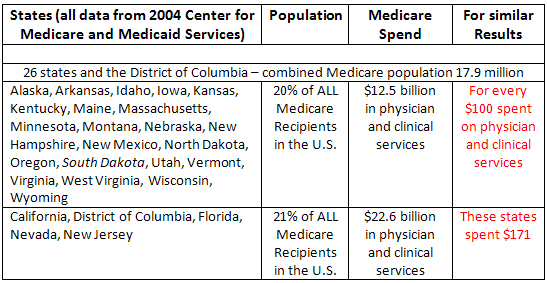
For that package, we look to Medicare. For years they have been adjusting for cost differences, urban and rural, north and south, rich and poor, and more. They built a relative rate structure to equalize medical service costs for all states. They built a level playing field.
If the field is not high enough to meet providers’ demands, a simple multiplier raises the entire field. One hopes that public option will find an efficient way to negotiate with providers.
In closing, there is a lot to like in public option once you understand what it is. I hope you like it and will support it too.
Download PDF Report >>> Stroger Hospital Press Conference
Filed under: Commentary, Healthcare Reform, Medicare & Medicaid | Leave a comment »



 Source Kaiser Family Foundation: Trends in Health Care Costs and Spending March 2009

 Health Reform Trends, Research and Analysis
Fact Check: Provider Consolidation Driving Up Costs
Download PDF Report >>> Fact Check – profits and consolidation
Fact Check: Provider Consolidation Driving Up Costs
FACT CHECK CHECKED: The above are arguments that America’s Health Insurance Plans (AHIP) included in their response to advocates of reform. What AHIP may not recognize is it has set forth some of the most compelling arguments for a “public option”.
AHIP freely admits that insurers are powerless on their own to control provider costs. Even with anti-trust exemptions, they have failed to combine forces and confront providers. Short of a government takeover, the only long-term solution is more clout. The only entity with more clout is the government itself being an insurer, which, by the way, it already is – Medicare.
Medicare doesn’t so much “ask” providers what they charge. Medicare almost “tells” providers what it will pay. Republicans were so concerned with Medicare’s clout that they wrote into law “prohibiting” negotiated drug discounts. But discounts will become necessary.
For many Americans, a drastically reformed healthcare system was a non-starter. The administration politically tried to blend features of the current into the proposed system to reduce upheaval to such a large part of the economy. Any change can be unsettling, and how you view it is very important. Is the glass half full or half empty? At some point, radical cost control will occur, and private insurers will not be leading the charge.
Insurers can look on government as an unreasonable competitor or they can look on government as the only insurer who finally has enough clout to contain provider costs. It may be that insurers eventually withdraw from the market for “essential medical benefits” and focus their efforts on supplemental policies that go beyond basic. If they did, they would look a lot like health insurers in Europe and other industrialized countries. Diminished compared to today but not destroyed.
Download PDF Report >>> Fact Check – profits and consolidation
Filed under: Commentary, Health Costs, Health Insurers, Healthcare Reform | Tagged: clout, government insurer, medicare, Powerless to control costs | Leave a comment »